Why Didn’t Joe Tsai’s Divorce Trigger Corporate Turmoil? Three Lessons from Hong Kong Family Trusts for Cross-Border Succession
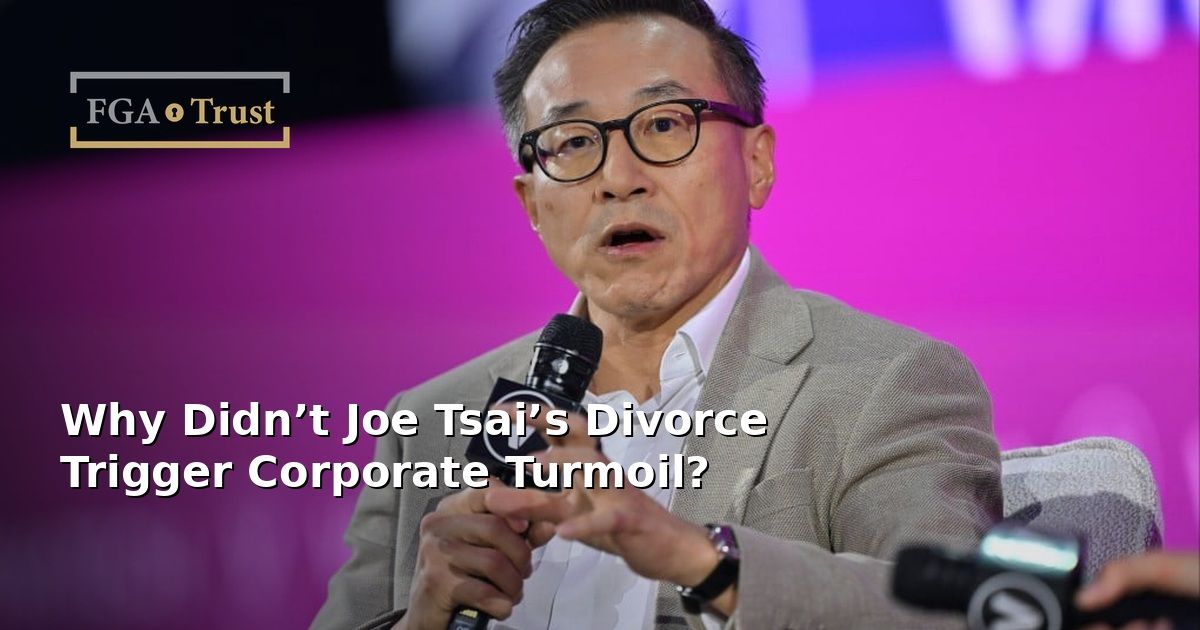
In August 2026, Alibaba Chairman Joe Tsai and Clara Wu Tsai jointly announced their divorce. Unlike similar past events, the market did not experience stock price volatility or concerns over control rights – share prices remained stable, investors stayed calm, and management saw no changes. The key to the whole matter lies not only in the "amicable split" statement itself, but also in the fact that Joe Tsai had already, years earlier, used a Hong Kong trust and offshore holding structures to institutionally separate share ownership, voting rights, and family interests, so that the change in marital status could not directly impact corporate ownership or decision‑making.
Looking back at the past, billionaire divorces without such institutional safeguards often ended in corporate and market disasters. Bezos’s divorce cost him $38.3 billion in Amazon shares; Bill Gates’s divorce triggered a restructuring of the world’s largest charitable foundation; SK Group chairman Chey Tae‑won’s divorce litigation dragged on for 10 years, with a payout of $643 million and infidelity scandals that damaged corporate image; China’s “Warren Buffett” Zhao Bingxian fought a 15‑year divorce battle involving domestic violence and safe‑box theft, eventually leaving his company without an actual controller. These cases prove that when core shareholdings are held purely in personal names, without layered holding structures and trust arrangements, personal relationship changes can easily escalate into corporate governance crises. The value of the Tsai case lies precisely here: a pre‑established Hong Kong family trust is not only a wealth succession tool but also the most effective “firewall” for maintaining business continuity and stabilizing cross‑border wealth planning.
The Real Risk of Divorce Lies in the Uncertainty of Control
When a major shareholder’s marital status changes, the market’s primary concerns are never about the details of asset division, but rather three specific questions: Will there be a large‑scale sale of shares? Will voting power be fractured? Will management and strategic decision‑making be disrupted? If core shareholdings are held entirely in personal names, without layered holding entities, voting authorizations, or family decision‑making mechanisms, a divorce can easily escalate from a private matter into a corporate governance crisis, triggering chain reactions of concern among investors, lenders, and clients.
The joint statement by Joe Tsai and Clara Wu Tsai immediately calmed the market precisely because it directly addressed these issues—confirming "no plans to sell Alibaba shares" and that "existing shareholdings and management roles at BSE Global, the Brooklyn Nets, and the New York Liberty will not be affected." While the statement did not disclose any private settlement terms, the "continuity" it conveyed was not improvised reassurance; it had long been embedded in the ownership structure through institutional design. For any cross‑border family, this is the first and most valuable lesson: do not wait until a relationship changes to think about control; separate ownership, management rights, and beneficial interests during stable times.
Why Can Hong Kong Trusts and Offshore Structures Stabilize Shareholdings and Management?
Public filings show that Joe Tsai’s Alibaba shareholding has long been held through offshore entities—including Parufam Limited (registered in the Bahamas) and PMH Holding Limited (registered in the BVI), of which he serves as a director and holds voting authorization. The Hong Kong Stock Exchange further records his interest as the "founder of a discretionary trust," listing the above companies as controlled corporations. Although these filings do not confirm that the trust is the sole legal vehicle, they do confirm that the trust’s role and holding layers were already in place long before the divorce announcement.
This is the core advantage of Hong Kong’s trust regime: under the Trustee Ordinance (Cap. 29), the trustee holds legal title and must act in the best interests of the beneficiaries, in accordance with fiduciary duties. For families that simultaneously hold listed company equities, private businesses, real estate, and cross‑border assets, a trust can achieve a four‑fold separation:
This institutional separation is precisely the foundation of cross‑border wealth planning and family business succession—especially when family members are distributed across Hong Kong, Mainland China, Japan, Southeast Asia, and North America, as a trust can effectively reduce risks arising from conflicts of law across different jurisdictions.
Lessons for Cross‑Border Families: Trusts Are a Long‑Term Strategy, Not a Remedial Fix
The soundest Hong Kong family trust should be established during a period of family harmony and business growth, rather than hastily assembled after a divorce, incapacity, relocation, or shareholder dispute. Effective planning must address in advance: Which assets support business development? Which assets sustain family living needs? Who has investment authority? How are distributions reviewed? If a beneficiary divorces or emigrates, how should the family respond?
It must also be objectively emphasized that a trust is not an absolute legal shield—courts and regulators may examine its substance, including the purpose of establishment, the degree of control retained by the settlor, and day‑to‑day administration records. Therefore, the real advantage comes from a transparent, compliant, and sustainable governance framework, continuously managed by a licensed professional institution (such as a Hong Kong TCSP), ensuring that documentation and actual practice remain aligned.
The public profiles of Joe Tsai and Clara Wu Tsai also remind us that family business continuity requires protecting not just capital, but also management expertise, institutional relationships, and succession opportunities for the next generation. The risks arising from unclear roles can sometimes be more damaging than asset division itself. The ultimate takeaway from the Tsai case is this: a public statement can only communicate pre‑existing continuity—it cannot create continuity out of thin air. Cross‑border families should engage early with independent legal, tax, and trustee advisors to establish a trust structure suited to their own needs, so that when life changes occur, business stability and market confidence can still be maintained.
Hong Kong family trusts are no longer merely estate planning tools for the end of life; they are institutional arrangements that span marriage, cross‑border investment, corporate financing, and next‑generation development across the full lifecycle. FGA Trust (License No. TC008341) specializes in working with high‑net‑worth families, entrepreneurs, and their independent advisors to establish and continuously manage appropriate Hong Kong trust and cross‑border succession structures, with a focus on corporate governance, compliance, documentation, and long‑term continuity. If you would like to learn how a well‑governed Hong Kong trust can support your business continuity, asset protection, and cross‑border wealth planning, please feel free to contact us.
Important Disclaimer: This article is for general informational purposes only and does not constitute legal, tax, matrimonial, or investment advice. The legal effects of a trust depend on applicable laws, specific facts, the trust deed, and the quality of ongoing administration. Readers should seek independent advice from qualified professionals in all relevant jurisdictions.