Jensen Huang’s NVIDIA Return: Family Trusts and Founder Wealth Planning
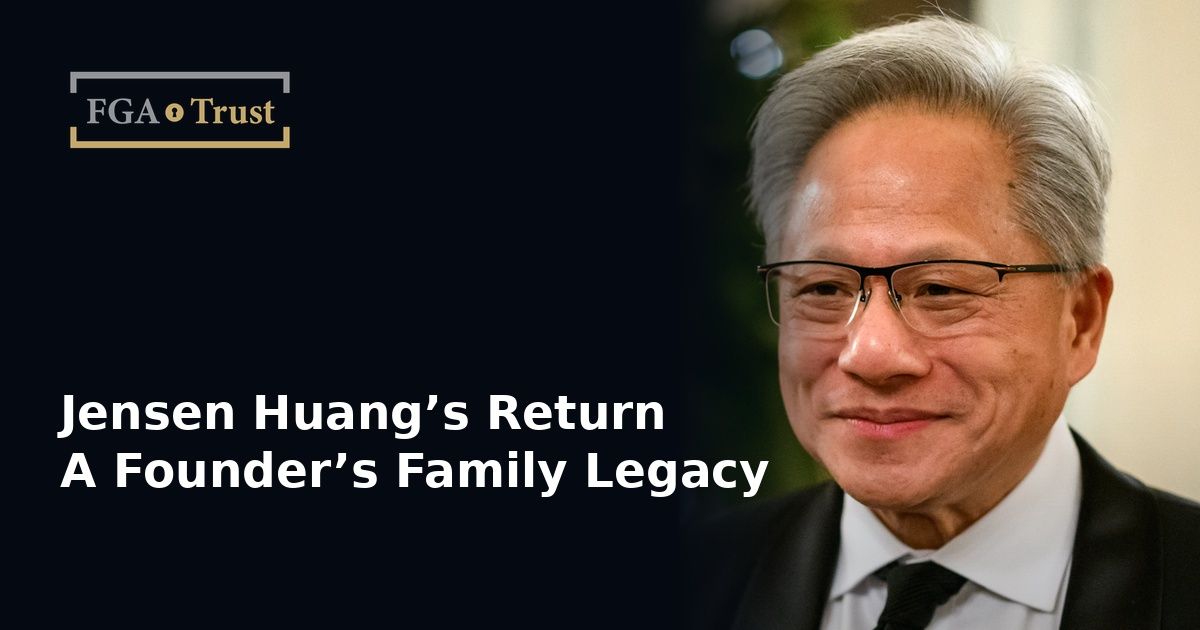
Jensen Huang’s return to NVIDIA highlights why founders and high-net-worth families should distinguish corporate leadership, share ownership and family benefits when planning for long-term wealth continuity.
On 23 November 2026, NVIDIA announced that its board had unanimously approved Jensen Huang’s immediate reinstatement as President, Chief Executive Officer and a director. Harvey C. Jones continues as board chair, while Colette Kress remains Chief Financial Officer following the end of her tenure as interim Chief Executive Officer. The company also stated that the independent board committee’s investigation continues.[1]
For entrepreneurs and high-net-worth families, the significance extends beyond a founder’s return to corporate leadership. When an individual’s management role changes, does the family still have clear, enduring arrangements for its wealth? If business holdings, household spending and succession all depend on the founder’s personal decisions, a single change of role can create uncertainty across several fronts.
A family trust cannot determine who becomes a listed company’s chief executive, nor can it guarantee a stable share price. Within the limits of applicable law and the trust deed, it can establish continuing arrangements for managing and distributing assets transferred into the trust. Families need not wait until a founder’s role changes to decide who has authority and who may benefit.
Corporate leadership, share ownership and family benefits are distinct
The appointment of a chief executive is a matter of corporate governance, governed by the company’s constitution, applicable law and board procedures. Shareholders’ voting rights depend on their actual holdings and the relevant arrangements. The economic benefits available to family members are a separate planning question. Owning shares does not allow someone to bypass the board when appointing management; being chief executive does not mean that their family finances are properly organised.
The official announcement explains the board’s decision to reinstate Huang. It does not suggest that a family trust brought about his return. This article therefore does not analyse his private trust arrangements, but uses the event to explore wealth continuity issues shared by founders and cross-border families.
For family businesses, separating these roles early is particularly important. The next generation may be beneficiaries without being suited to running the business. Professional managers may oversee operations without needing to own family assets. Treating management succession and beneficial interests separately can help prevent questions of who runs the business and who benefits from becoming a single dispute.
How can a family trust support continuity in a founder’s shareholdings?
Where a trust has been validly established and assets properly transferred, trustees hold legal ownership of the trust assets and manage them under the trust deed and applicable law, fulfilling their duties to beneficiaries. For families with business shareholdings, this can provide a framework that continues beyond an individual’s lifetime or changes in their role, rather than leaving each family transition to affect personally held shares directly.[2]
Planning involves more than placing shares into a trust. It must clarify who exercises shareholder rights, how dividends are handled, and what procedures apply to a sale or pledge of shares. Where a holding company is involved, the trust deed, company constitution and shareholder agreement also need to work together. Trustees cannot act beyond their powers or take over responsibilities belonging to the company’s board.
An entrepreneur may, for example, wish to retain a core business over the long term while funding children’s education and household needs. An appropriate trust arrangement can establish continuing procedures for shareholding management and distribution decisions. Whether funds are sufficient, or whether shares should be sold or other investments made, still requires a separate assessment of cash flow, asset risks and beneficiaries’ needs. A family trust is a governance tool, not a promise of business value or investment returns.
Establish decision-making procedures before they are needed
If a founder is temporarily unable to work, loses capacity or dies, families often need clarity on who can act and how existing arrangements will continue. Where only the founder holds the instructions, documents and external contacts, even a wealthy family may struggle to meet everyday needs promptly.
A trust deed can set review procedures for major asset sales, share pledges and substantial distributions. Where permitted by law and the deed, it may also require two trustees to make decisions jointly, or a protector’s consent for specified matters. These are not automatic features of every trust: the relevant powers must be clearly defined when the arrangement is established.[2]
An additional approval requirement does not necessarily make an arrangement more robust. Disagreement between two trustees, or a protector’s inability to act, can bring decisions to a standstill. Successor appointments, conflicts of interest and deadlock resolution therefore also need to be addressed. Effective governance is not simply about restricting who may decide; it ensures that appropriate people can make lawful, timely decisions when needed.
Business equity is not the same as readily available family funds
A founder’s wealth may be heavily concentrated in the business they built. Strong performance can make assets appear substantial on paper, yet shares may not be readily saleable and dividends may not cover household spending. If the founder’s management role and the company’s prospects change together, personal income and the value of their main asset may be exposed to the same source of risk.
Family trust planning should therefore consider both business holdings and family liquidity. Education, healthcare and retirement should not depend solely on assumed future dividends or an eventual share sale. Families can assess whether to hold separate liquid assets and set out distribution purposes and decision-making principles in the trust deed.
Trustee ownership does not remove business risk or market volatility. A trust neither diversifies assets automatically nor prevents a fall in share prices. Its value lies in establishing clear responsibility for holdings, cash flow and beneficiary arrangements, with appropriately qualified advisers helping to assess investment risks.
Why might cross-border families consider a Hong Kong trust?
For families whose members live in different countries and whose business and financial assets span several jurisdictions, Hong Kong can serve as a base for trust establishment and administration. The Trustee Ordinance (Cap. 29) forms part of the relevant legal framework. Actual powers and duties must still be assessed alongside common law, the trust deed and the laws where assets are situated.[2]
Hong Kong law allows a settlor to retain certain investment or asset management powers without that retention alone invalidating the trust. This does not give the settlor unrestricted control over every matter, nor does it mean that tax authorities or courts in other jurisdictions will necessarily treat the arrangement in the same way.[2]
Before shares in a US-listed company are transferred into a Hong Kong trust, for example, applicable securities disclosure obligations, dealing restrictions and tax requirements should be reviewed in light of the holder’s status and the specific arrangements. A family member’s subsequent relocation may also change reporting and tax obligations. A Hong Kong trust is not a cross-border tax exemption or a means of avoiding disclosure; applicable customer due diligence and tax information reporting requirements must still be met.[3]
How can FGA Trust support founders and high-net-worth families?
For entrepreneurs considering a family trust, the starting point is not its name or structure. It is identifying which assets need continuing management, which expenses require dependable support, and who can lawfully fulfil the relevant responsibilities if the founder’s role changes.
FGA Trust (TCSP Licence No. TC008341) can work with entrepreneurs, beneficiaries and their independent legal and tax advisers on family trust establishment and ongoing administration, helping translate family objectives into appropriate documentation and management arrangements. A trust or company service provider licence is not an investment management, banking or securities business licence. Where activities require separate authorisation, they must be provided by appropriately authorised institutions.[4]
Huang’s return to NVIDIA is a reminder that a founder’s role can change. For high-net-worth families, the more enduring question is whether business holdings and family wealth can continue under clear, compliant procedures when the founder no longer handles every matter personally.
If you are considering a Hong Kong family trust, business shareholding succession or cross-border wealth planning, contact FGA Trust to discuss arrangements suited to your family.
This article is for general information and education only, not legal, tax or investment advice. It does not imply any client or partnership relationship between Jensen Huang or NVIDIA and FGA Trust. Individual arrangements should be assessed by professional advisers in the relevant jurisdictions.
References
[1] NVIDIA board reinstatement announcement dated 23 November 2026
[2] Hong Kong Trustee Ordinance Cap. 29
[3] Hong Kong Inland Revenue Department AEOI frequently asked questions
[4] SFC licensing guidance including the trust company exemption