
China Offshore Trust Reporting Deadline: Why Should HNW Families Establish a Hong Kong Trust Early?
22 October 2026 is a significant date in China’s transitional individual income-tax arrangements for offshore trusts. For entrepreneurs holding family assets, listed-company shares or offshore investments through Hong Kong, the Cayman Islands, the British Virgin Islands or other overseas jurisdictions, it is more than a filing date. It is an opportunity to test whether the cross-border trust structure, tax-residence analysis and supporting records present one coherent account.
Market estimates place the overseas wealth of leading Chinese entrepreneurs at about US$140 billion, illustrating why offshore trusts, overseas ownership and actual control have returned to the compliance agenda for high-net-worth families. The figure is not a tax conclusion about any individual. Its relevance is that offshore ownership, an overseas listing or a trust arrangement does not, by itself, place the relevant income, asset transfer or actual control beyond China’s tax rules.
The Pan Shiyi case: why public trust structures are back in focus
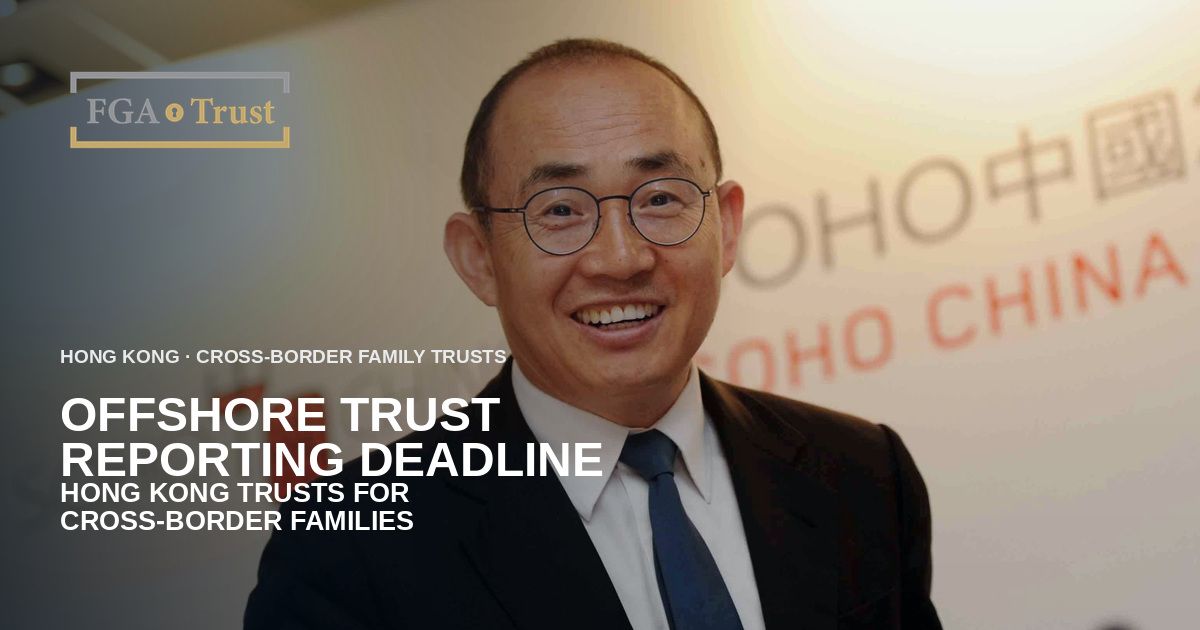
SOHO China founders Pan Shiyi and Zhang Xin are a prominent public example frequently cited in recent coverage. SOHO China’s 2025 annual report discloses that Pan is a beneficiary of a discretionary trust founded by his spouse, Zhang Xin Marita. The report also describes the trustee’s holding of SOHO China shares through Cayman Islands and BVI companies. These are public listed-company disclosures concerning ownership and trustee arrangements.
In August, the South China Morning Post cited Pan’s Cayman trust in its discussion of how China’s new rules have returned established offshore wealth structures to the market spotlight. Public disclosure and media attention are not, however, evidence that any particular person owes tax, has made a filing or has breached a rule. The lesson for other families is different: where a trust holds listed-company interests, overseas companies or cross-border assets, the trust deed, funding source, actual control, asset flows and tax-residence facts should be capable of clear, consistent explanation.
This is also why terms such as “Pan Shiyi offshore trust”, “China family trust” and “Hong Kong trust structure” have become high-intent search terms. For most readers, the substantive question is not how much tax a named entrepreneur may pay, but whether their own family trust now requires a disciplined review.
What does Announcement No. 21 change?
On 24 July 2026, China’s Ministry of Finance and State Taxation Administration issued Announcement No. 21 on individual income-tax matters concerning offshore trusts. The Announcement addresses three distinct stages: the transfer of property into an offshore trust, income arising during the life of the trust, and its termination or liquidation.
For resident individuals, transferring company shares, listed securities, real estate or other property into an offshore trust may give rise to “income from transfer of property”. Income generated during the life of a resident-funded offshore trust, including income of certain underlying overseas entities, may also be reportable by the resident individual under the Announcement, even where it has not been distributed. The rules also address termination, liquidation, changes in tax-residence status, actual control and indirect economic benefits.
Article 17 contains transitional treatment for certain historic unpaid tax. It covers specified unpaid tax relating to property transferred by resident individuals into offshore trusts from 2023 to 2025, together with the treatment of certain trust income before 1 January 2026. Official guidance states that taxpayers within the identified transitional categories may report and pay within 90 days of implementation without a late-payment surcharge; current reporting commonly identifies 22 October 2026 as the end of that period.
This does not mean that every offshore trust, or every beneficiary, has the same obligation on 22 October. Applicability depends on whether the relevant person is a PRC tax resident, who actually funded the structure, when assets were transferred, how the trust and its underlying entities operate, how income arose or was used, and other specific facts.
The value of a Hong Kong trust: a durable governance foundation for cross-border families
As China’s offshore-trust tax rules become more specific, more families are considering whether to establish a Hong Kong trust early. The starting point should not be how to avoid reporting. Rather, it should be how the family wishes to hold, govern, transfer and document cross-border assets. A Hong Kong trust does not automatically remove PRC tax obligations, and the answer cannot be determined by its place of establishment alone.
The Announcement defines an offshore trust to include a trust established under foreign law and other overseas legal arrangements with trust-like functions. The official explanatory note also emphasises substance over form. Where a person actually funds, bears or controls property, the name of a nominal holder or intermediate company cannot be the whole analysis.
PRC tax-residence status cannot be determined by a passport, foreign nationality or permanent-residence document alone. The Announcement says that an individual who has obtained foreign nationality or overseas long-term or permanent residence may still be treated as a PRC-domiciled resident individual if their principal economic interests remain in mainland China. The purpose of a Hong Kong trust is therefore not to provide a “no reporting” answer. Its value lies in establishing a disciplined framework for the ownership of family assets and operating businesses, governance authority, distribution principles, succession arrangements and documentary responsibilities at an early stage. As life, family, business or regulatory circumstances change, a trust under the continuing administration of a licensed Hong Kong trustee can help a family maintain reconcilable records, clear decision-making and cross-border professional coordination within a lawful, compliant framework.
Five questions to review as the transition period ends
Who actually funded and who actually controls the structure? Reconcile the original source of assets, funding arrangements, settlor powers, protector powers, investment or distribution powers, and the practical roles of directors or authorized signatories of underlying entities. A trust chart may not capture the complete tax fact pattern.
Could any relevant person currently be a PRC tax resident? This requires a fact-specific assessment of residence, principal economic interests, personal and family connections, assets and business activity. An independent PRC tax adviser should make this assessment; immigration documents and the trust’s jurisdiction are not sufficient in themselves.
What has happened in the trust since 2023? Prepare a chronology covering establishment, asset transfers, share or investment disposals, dividends, interest, sale proceeds, distributions, loans, guarantees, personal use of trust assets, liquidation and restructuring. The records of Hong Kong, Cayman, BVI and underlying entities should reconcile.
Are the trust and financial records complete? The trust deed, amendments, letters of wishes where relevant, shareholder and director registers, valuation material, financial statements, banking and custody records, distribution resolutions, tax filings and evidence of foreign personal income tax paid may all be relevant. The Announcement provides for credit, subject to applicable law, for qualifying foreign personal income tax paid in relation to the offshore trust.
Who can connect Hong Kong trust records with PRC tax advice? Cross-border families often have the necessary documents, but they may be dispersed among trustees, family offices, overseas companies, investment advisers, accountants and family members. Without a reconciled central record, an approaching deadline can expose inconsistent information, unclear authority or an inability to evidence important facts.
A rushed restructuring is not a compliance solution
One of the most hazardous messages around a closing transitional period is that ending a trust, moving assets, changing nationality, replacing beneficiaries or creating a new structure will resolve the issue once and for all. The Announcement addresses the establishment, life and termination of a trust. It also contains provisions on actual control, deemed distributions and changes in tax-residence status.
Before undertaking a restructuring, termination, disposal, further funding, distribution, loan or guarantee, a family should obtain independent PRC tax and legal advice on its own facts and maintain a clear record of its decisions. The first compliance step is not an abrupt change; it is a reliable review of the existing structure and its history.
How FGA Trust helps protect Hong Kong cross-border family trust structures
As a Hong Kong licensed trust or company service provider, FGA Trust, TCSP Licence No. TC008341, works with high-net-worth families, entrepreneurs and their independent advisers to establish and continuously administer Hong Kong cross-border family trusts for succession, corporate governance and cross-border administrative needs. We help to put in place clear trust documentation, ownership and authority records, and distribution and administrative processes, so that a family can maintain an orderly, reconcilable governance foundation across jurisdictions. For China-connected families, FGA Trust can coordinate discussions with appropriately qualified PRC tax and legal advisers.
FGA Trust does not provide PRC tax or legal advice, calculate individual tax liabilities, or represent that a Hong Kong trust removes any person’s reporting or tax obligations. Our role is to help a family maintain clearer governance, reconcilable documentation and a more disciplined foundation for cross-border professional coordination.
If you are considering establishing a Hong Kong trust early for family assets, business equity or next-generation succession—or reviewing an existing arrangement—contact FGA Trust.
This article is for general educational purposes only. It is not PRC, Hong Kong or other legal, tax, accounting, investment or regulatory advice. References to Pan Shiyi and Zhang Xin concern only a publicly disclosed listed-company trust arrangement and related media coverage; they do not comment on any individual’s tax liability, filing status or compliance outcome. The application of Announcement No. 21 depends on individual facts. Obtain independent PRC tax and legal advice before taking or refraining from any action.